OneProt: Towards Multi-Modal Protein Foundation Models via Latent Space Alignment of Sequence, Structure, Binding Sites and Text Encoders
PLOS Computational Biology 21(11), e1013679·journal
Abstract
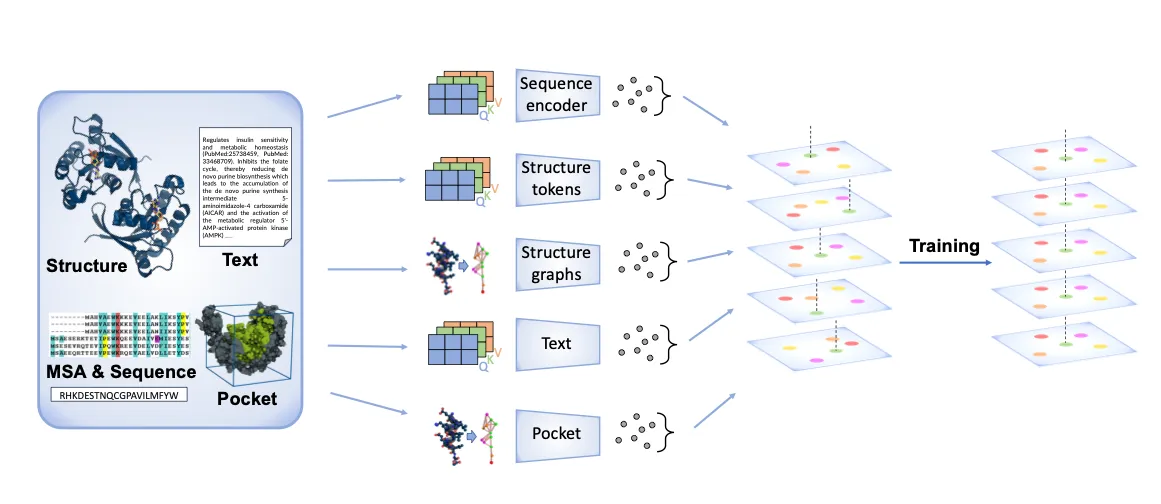
Recent AI advances have enabled multi-modal systems to model and translate diverse information spaces. Extending beyond text and vision, we introduce OneProt, a multi-modal AI for proteins that integrates structural, sequence, alignment, and binding site data. Using the ImageBind framework, OneProt aligns the latent spaces of modality encoders along protein sequences. It demonstrates strong performance in retrieval tasks and surpasses state-of-the-art methods in various downstream tasks, including metal ion binding classification, gene-ontology annotation, and enzyme function prediction. This work expands multi-modal capabilities in protein models, paving the way for applications in drug discovery, biocatalytic reaction planning, and protein engineering.
OneProt shows how multi-modal protein data (sequences, 3D structures, binding sites and text annotations) can be folded into a single coherent latent space using the ImageBind framework. Each modality keeps its own encoder; alignment happens along the primary protein sequence, which acts as the anchor modality.
The result is a model that retrieves across modalities and transfers well: it beats state-of-the-art baselines on metal ion binding classification, gene-ontology annotation and enzyme function prediction, without task-specific architectures.